The trapezoid Rule

 Determination and comparison of areas bounded by a known curve  ( sin x , cos x, straight line , circle , parabola , ellipse ) by definite integration and by dividing the total enclosed area into given number of small trapezium ( i.e dividing the given interval into number of small subintervals , taking 3 values of h .

The trapezoid rule is used to approximate the area under a graph or to approximate the value of an integral .
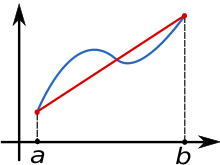


In calculus , the trapezoidal rule is a technique for approximating the definite integral.
The trapezoidal rule works by approximating the region under the graph of  the function f(x) as a trapezoid and calculating its area . 
 
The integral can be better approximated by partitioning the integration interval ,applying the trapezoidal rule to each subinterval and summing the result .Let { xₖ } be a partition of  [ a,b] such that a = xₒ< x₁< .................xₙ₋₁ < xₙ = b and △ xₖ be the length of the k-subinterval (  △ xₖ =  xₖ -xₖ₋₁) then 


When all   △ xₖ have the same value  △ x the formula becomes 


Error (E) = (True value - approximate value )/True value   x    100 %                                                                                               
                                                                                                           
The approximation becomes more accurate as the resolution of the partition increases ( that for larger n all △ xₖ decrease ) 
Calculation of area under f(x) =  sin x  curve by trapezoidal rule .
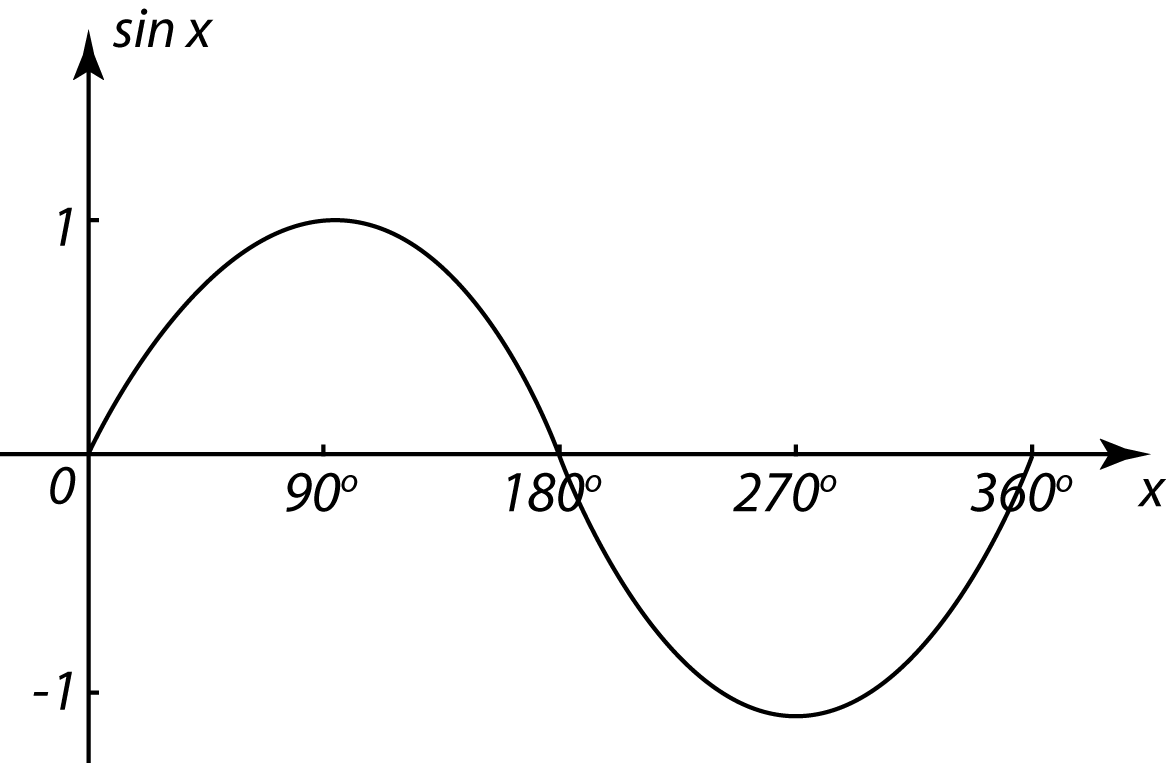

i) In this question , f(x) = sin x and let [a,b] = [0,π ] and n =10 
so we get Δx=h  = (b-a)/10 = π/10 
The points are a=x₀ = 0 , x₁ = π/10 , x₂ = 2π/10, x₃ = 3π/10, .......................x₉ =9π/10,x₁₀ =10π/10=b 
Now applying the formula for f(x) =  sin x

= π/20 ( sin 0 +2  sin  π/10  + 2 sin 2 π/10  + 2 sin 3 π/10  + .....................2 sin 9 π/10  + sin π ) 
= π/20( 0 + 0.6180 + 1.1756 + 1.6180 + 1.9021 + 2 + 1.9021 + 1.6180 +1.1756 + 0.6180 + 0 ) 
= π/20 ( 12.6274 ) = 1.9835 
Here actual integral ( area) is 
π                         π                   
⎰sin x = - cos x | =  1 + 1 = 2 
0                          0                      

So the error is ∆⎰f(x) = (2- 1.9835)/2 = 0.825 % 

ii) If we take the interval reduced to n = 5 then the points will be -
a = x₀ =  0 , x₁ = π/5 , x₂ = 2π/5, x₃ = 3π/5, x₄ = 4π/5, x₅= 5π/5= b 
applying  the above rule 
we get the area under the cure 

 π/10( sin 0 + 2 sin  π/5 + 2 sin 2 π/5 + 2 sin3 π/5 + 2 sin4 π/5 + sin π) 

 π/10 ( 0+ 1.1756 + 1.9021 + 1.9021 + 1.1756 + 0) 
 π/10( 6.1554 ) 
= 1.9338 
Hence the error ;
∆f(x) = (  2 - 1.9338) /2 x 100 % = 3.31 %  

iii) If the intervals becomes equal to n = 7 then the points will be
a = x₀ = 0 , x₁ = π/7 ,  x₂ = 2π/7 ,x₃ = 3π/7 , x₄ = 4π/7 , x₅= 5π/7 , x₆ = 6π/7 x₇ = π  = b 
The area under the curve sin x in the interval [ 0, π] will be - 
π/14 ( sin0 + sin π/7 + 2sin 2π/7 + 2sin 3π/7 +2 sin 4π/7 + 2sin 5π/7 + 2sin 6π/7 + sin 7π/7 ) 
= π/14( 0 + 0.8678 + 1.5637 + 1.9499 +1.9499 + 1.5637 + 0.8678 + 0 ) 
= π/14 ( 8.7628 ) 
= 1.9664 

So the error = (2 - 1.9664 )/2  x 100 % =  1.68 % 

Error gets reduced when the number  intervals increase . For n=10 error is minimum . for n= 5 is maximum . 

Determination of the area under the curve f(x) = cos x from trapezoidal rule and its comparison with the actual value for three different values of h i.e ∆ x . 


Let us take the interval-
 [a,b] = [0,π/2] 
i) First we take the partition corresponding to n = 5 , then the points are 
a = x₀ = 0 , x₁ = π/10 , x₂ = 2π/10 , x₃ = 3π/10 , x₄ = 4π/10 , x₅ = 5π/10 = b 
Applying the trapezoidal formula i.e 



we get the area (T)from the trapezoidal rule ,
T = π/20( cos 0 + 2 cos π/10 + 2 cos 2π/10 + 2 cos 3π/10 + 2 cos 4π/10 + cos 5π/10 ) 
= π/20 ( 1+ 1.90221 + 1.61803  + 1.17557+ 0.61803 + 0 ) 
π/20 ( 6.31384 ) 
= 0.99170 
                                            π/2                        π/2             
Value of the actual integral = ⎰ cos x dx = sin x | =  1 - 0 = 1 
                                       0                           0        
error = (1-0.99170 )/1 x 100%  = 0.83 % 

ii) If  we take partition corresponding to n = 7  then the points become ,
a = x₀ = 0 ,  x₁ = π/14 , x₂ = 2π/14 ,  x₃ = 3π/14 , x₄ = 4π/14 ,x₅ = 5π/14 , x₆ = 6π/14, x₇ = 7π/14 = b 
Hence , 
T = π/28 (  cos 0 + 2cos π/14 +2cos 2π/14 + 2 cos 3π/14 + 2 cos 4π/14 + 2 cos 5π/14 + 2 cos 6π/14 + cos π/2 ) 
=  π/28( 1 + 1.94985 + 1.80193 +1.56366 +1.24697 +0.86776 +0.44504 +0 ) 
=  π/28 ( 8.87515 )
=0.99578 
Hence error = ( actual value - calculated value )/actual value  x 100 % 
= (1- 0.99578) /1 x 100 % = 0.4210 % 

iii) For partition corresponding to n = 10 the points are : interval = [a,b] = [0,π/2] 


a = x₀ = 0 , x₁ = π/20 , x₂ = 2π/20 ,  x₃ = 3π/20 , x₄ = 4π/20 , x₅ = 5π/20, 
x₆ = 6π/20, x₇ = 7π/20 , x₈ = 8π/20, x₉ = 9π/20, x₁₀ = 10π/20 = b 
Hence under trapezoidal rule the integral becomes 
T = π/40 ( cos 0 + 2cos π/20 + 2 cos 2π/20 +2 cos 3π/20 + .................+ 2cos 9π/20 + cos 10π/20 ) 
= π/40( 1+ 1.97537 + 1.90211 + 1.78201 +1.61803 + 1.41421 + 1.17557+ 0.90798 + 0.61803 + 0.31286 + 0 ) 
= π/40 ( 12.70617 ) 
= 0.99794 
 Error =  ( 1- 0.99794) /1 x 100 % =  0.20 %  
Importance: 
Importance of Trapizoid rule is that it can help to get approx. Value of area under curve.
Especially when we do not perform the definite integration due unknown functional formula we can resort to the trapezoid rule for evaluation of the area under the curve.

Calculation  of  area bounded by a straight line - 


Here f(x) = 2x  , let the interval [a.b ] = [0,2] and the partition ,n = 5 ,
the points of subintervals are : 
a= x₀ = 0, x₁ = 2/5 =0.4 , x₂ = 0.8 , x₃ =1.2 , x₄ = 1.6 , x₅ = 2 =b 
Applying the trapezoid rule for the interval  [0,2] we get the value of the integral 
T = 0.4/2 ( f(x₀) +2 f(x₁) + 2 f( x₂) + 2 f( x₃) + 2f( x₄) + f(x₅) 
= 0.2 ( 0 + 1.6 + 3.2 + 4.8 + 6.4 + 4 ) 
=0.2 x 20 
= 4 
The actual value of the integral is given as 
   2               2                  2           
∫ f(x) dx = ∫ 2x dx = x²| =   4 
0               0                 0         
Error = (actual value - value from the trapezoid rule )/actual value x 100 %  =  (4-4 )/4 x 100 % = 0 % 
Here the error is zero because the cure is a straight line as there is no left out area between the considered trapeziums and the actual cure (straight line) . The integral is independent of partitions . So the value of the integral remain same (ie 4) for the partitions corresponding to n= 7 and n = 10 . 
Calculation of area bounded by a circle : 


Equation of a circle may be represented by ,
x² + y² = 5² 
It can be written as ,
 y² = 5² - x² 
Hence , f(x) = y = √(5² - x² ) , We apply the trapezoid rule for the interval [a,b] = [0,5] 
i) Let us the evaluate the area corresponding to partition , n = 5 , △x = 5/5 = 1 
    The points are : a = x₀ = 0, x₁ = 5/5 =1 , x₂ = 2, x₃ = 3 , x₄ = 4 , x₅ = 5 
Applying the trapezoid rule - 
T =  △x/2 ( f(x₀) + 2f(x₁) + 2f( x₂ ) +2 f(x₃) +2f(x₄) + f(x₅) ) 
= 0.5( 5 + 9.79795 + 9.16515 +8 + 6 + 0 ) 
=  0.5 x 37.9631 =18.98155 
The actual integral is : 
(π x 5² )/4 = 19.63495 
So, the error(Δ₁)= (19.63495 - 18.981550)/19.63495 x 100 % =  3.32 % 
ii) Now let us consider the evaluation of integral for divisions  n = 7 i.e △x = 5/7 = 0.71428 
The points are : 

 a = x₀ = 0,  x₁ = 5/7 = 0.71428 , x₂ = 1.42856 ,  x₃ = 2.14284 , x₄ = 2.85928 ,  x₅ = 3.57356 , x₆ = 4.28568 , x₇ = 5 
From the trapezoid rule we the value of area -
T = △x/2 ( f(x₀) + 2f(x₁) + 2f( x₂ ) +2 f(x₃) +2f(x₄) +2 f(x₅) + 2f(x₆) + f(x₇)
0.71428/2 ( 5  + 9.89743+ 9.58315 + 9.03509 +8.20354 + 6.99418 +5.15090 + 0 ) 
= 0.35714 ( 53.86429 ) 
=19.23709
Error (Δ₂) = (19.63495 - 19.23709) /19.63495 x 100 % = 2.02 %  

iii) For  division corresponding to n = 10 and △x = 5/10 = 0.5 
The interval points are : 

= x₀ = 0 , x₁ = 5/10 =0.5 , x₂ = 1.0 ,   x₃ = 1.5 , ........x₉ = 4.5 , x₁₀ = 5 
From trapezoidal rule area will be -
T = △x/2 ( f(x₀) + 2f(x₁) + 2f( x₂ ) +2 f(x₃) +2f(x₄) +2 f(x₅) + 2f(x₆) +2 f(x₇) + 2 f(x₈) + 2f(x₉) + f(x₁₀) )
= 0.5/2 ( 5 + 9.94987 + 9.79795 + 9.53939 + 9.16515 + 8.66025 + 8 + 7.14142 + 6 + 4.35889 + 0  )
= 0.25 ( 77.61292 ) 
=19.40323 
Error(Δ₃) =( 19.63495 - 19.40323)/19.63495  x100 % = 1.18 % 
Obviously error gets reduced as divisions increase . as Δ₃ < Δ₂ <Δ₁ 
The standard equation of parabola is : 
y² = 4a x 


Let us take the equation y² = 4 x 
Hence f(x) = y = 2 √x 
Let us take the interval [a,b] = [0,4] 
The integral in the interval is : 
                        4                 4                                  4           
           ⎰f(x) dx  = ⎰2 √x dx  = 4/3 x^3/2 |
           0                0                                  0
=4/3 ( √4³ - 0 ) 
(8 x 4)/3 = 32/3 = 10.66666 

i) For division n= 5 i.e 🛆x = 4/5 = 0.8
The points are 
a= x₀ = 0,  x₁ = 0.8 ,  x₂ = 1.6 , x₃ = 2.4, x₄ = 3.2 , x₅ = 4 
The approximate value from the trapezoidal rule - 
T = 🛆x/2 ( f( x₀ ) + 2f(x₁) +2f( x₂) +2f( x₃ ) + 2f( x₄ ) + f( x₅) ) 
= 0.8/2 ( 0 + 3.57770 + 5.05964 +6.19677 + 7.15541 +4 ) 
=0.4 ( 25.98952 ) 
= 10.39580 
So the error (△ ) = (10.66666- 10.39580)/10.66666 x 100 % 
= 2.539 % 

ii) For n = 10 and 🛆x = 4/10 = 0.4 
The partition points are -  
a= x₀ = 0 , x₁ = 0.4 , x₂ = 0.8 , ----------------------+ x₉ = 3.6 . x₁₀ = 4 = b

Hence  - 
T = 🛆x/2 ( f( x₀ ) + 2f(x₁) +2f( x₂) +2f( x₃ ) + 2f( x₄ ) + 2 f( x₅) + ------------------+2f(x₉) + f(x₁₀) ) 
= 0.4/2 ( 0 + 2.52982 + 3.57770 + 4.38178 + 5.05964 + 5.65685 + 6.19677 +6.69328 + 7.15541 + 7.58946 + 4 )
= 0.2 ( 52.84071 ) 

= 10.56814 
So the error = (10.66666 - 10.56814)/10.66666  x 100 % 
= 0.92 %  

iii) For division corresponding to n = 16 and 🛆x = 4/16 = 0.25 
The partition points are : 
a= x₀ = 0 , x₁ = 0.25 ,x₂ = 0.5 , x₃ = 0.75 , --------------------------,x₁₅ = 3.75 , x₁₆ = 4 
So the estimated value -
T = 🛆x/2 ( f( x₀ ) + 2f(x₁) +2f( x₂) +2f( x₃ ) + ---------------------,2 f(x₁₅) + f( x₁₆) )
0.25/2 ( 0 + 2 +2.82842 +3.46410 + 4 + 4.47213+ 4.89897+5.29150 + 5.65685+6 +6.32455+6.63324+6.92820+ 7.21110+7.48331 +7.74596 + 4 ) 
= 0.125 (  84.93833 )
= 10.61729 
Hence the error = (10.66666- 10.61729)/10.66666 x100% 

= 0.46 % 

Now let us evaluate integral for Ellipse from Trapezoid rule .


We assume the elliptical curve as x²/9 + y²/4 = 1 
⇒  y² = 4(1- x²/9) 
∴  y = 2 √ (1 -  x²/9) = 2/3√ (9 -  x²) =f(x)
We perform the integration in the interval [a,b] = [0,3] 
So the integration ,
3                 3                   
⎰f(x) dx = ∫2/3√ (9 -  x²)
0              0                    

                                                         3
= 2/3 [ x/2√ (9 -  x²) + 9/2 sin⁻¹ x/3 ]
                                                          0
= 2/3 [ 9/2 π/2 ]
= 3/2  π = 4.71239
i) Now apply the trapezoid rule for the interval  [a,b] = [0,3] and n = 5 , 🛆x = 3/5 = 0.6 
f(x)= 2/3√ (9 -  x²) 
The partition points are given below 
a =  x₀ = 0, x₁ = 0.6 , x₂ = 1.2 ,x₃ = 1.8 , x₄ = 2.4 ,x₅ = 3 = b 
⇒ T = 🛆x/2 (  f( x₀ ) + 2f(x₁) +2f( x₂) +2f( x₃ ) + 2f( x₄ ) + f( x₅) )
= 0.6/2  x2/3 ( 3 +5.87877 +5.49909 + 4.8 +3.6 + 0) 
=0.3 x2/3 ( 22.77786)
= 4.55557 

Error = (4.71239 - 4.55557 )/4.71239 x 100 % =  0.033 x100 % = 3.3 % 
ii) For partitions corresponding to n = 10 , ∆x = 3/10 =0.3 , f(x)= 2/3√ (9 -  x²)
Partition points are : 
a =  x₀ = 0, x₁ = 0.3 , x₂ = 0.6 ,,x₃ = 0.9 ,------------------------+ x₉ = 2.7 , x₁₀ = 3 =b 
⇒ T =  🛆x/2 (  f( x₀ ) + 2f(x₁) +2f( x₂) +2f( x₃ ) + -----------------+2 f(x₉) +f(x₁₀) 
=0.3/2 x 2/3 ( 3+ 5.96992 + 5.87877 + 5.72363 + 5.49909 + 5.19615 + 4.8 +4.28485 +3.6 +2.61533 + 0 )
= 0.1 x ( 46.56774) 
= 4.656774 
Error =( 4.71239 - 4.656774 )/ 4.71239 x 100 % = 1.18 % 
iii) For n = 15 ,  ∆x = 3/15 = 0.2 
Partition points are ; 
a =  x₀ = 0,  x₁ = 0.2 ,  x₂ =0.4 , x₃ = 0.6 ,-------------------,x₁₄ = 2.8, x₁₅ =3 =b 
⇒ T =  🛆x/2 (  f( x₀ ) + 2f(x₁) +2f( x₂) +2f( x₃ ) +------------+ 2f(x₁₄) + f(x₁₅) 
= 0.2/2 x2/3(3 + 5.98665 +5.94642 + 5.87877 + 5.78273 + 5.65685 + 5.49909 + 5.30659 + 5.07543 +4.8 +4.47213 +4.07921 +3.6 + 2.99332 +2.15406 + 0) 
= 0.06666 ( 70.23125  ) 
= 4.68161 
So the Error = (4.71239 - 4.68161)/4.71239 x 100 % 
= 0.65 % 
Error gets reduced as the partition increases .

Inferances :
From the above discussion and examples we may come to the conclusion that for summation or integration of a function accuracy increases as the number of divisions increase in the application of trapezoid rule. Here the value we get is an approximation . But  the approximation gets more closer to actual value as the number of partitions become larger .           

 Matrix 

History of Matrices : 

The concept of a matrix dates back to ancient times , but was first referred to as a matrix in 1850 by James Joseph Syluester . They were first used between 300 BC and AD200 in a Chinese text called Nine Chapters of Mathematical Art by Chiu Chang Suan Sher written during the Han Dynasty which had the idea of determinants and solving system of equations with a matrix .The Babylonian also studied matrices but the Chinese did much more study into them .One of the Chinese matrix methods is commonly known today as Gaussian Elimination .The theory of matrices was developed by a mathematician named Gottfried Leibniz . He first took out co-efficients of linear equations and put them in a matrix . Then Carl Gauss further developed the matrix theory in the late 1700s .He added matrix multiplication , inverse and Gaussian Elimination . Gaussian Elimination method to solve system of equations with 3 or more variables , and it involves getting most matrix numbers to zero or an identity matrix . This is done doing " elementary row operations " .This method was also actually in the Chinese text, but Gausess rediscovered it . 

Matrix(Introduction) : 

A matrix is a rectangular array or table of numbers , symbols , or expressions arranged in rows and columns , which is used to represent a mathematical object or a property of such an object . 

Example : 

                      1   7  -10   

                      3   5   -20 

The above is a matrix of two rows and three columns . This is 2 x 3 matrix or a matrix of dimension 2 x3 .

Size : 

The size of a matrix is defined by the number of rows and columns it contains . A matrix with  'm' rows and 'n' columns is called an 'm x n' matrix . 

Square matrix : 

A matrix with the same number of rows and columns is called square matrix . 

                                                         9  13  5 

                                                         1  10  7 

                                                          3  7    9 

The above is a 3 x3  square matrix . 

A = 
Notation : 
Matrices are commonly written in box brackets .
Matrices are usually symbolised using upper case ( such as A in the example above ) while the corresponding lower-case letters with two subscript indices represent the entries .
Basic operations : 
Addition : The sum A + B of two m-by-n matrices A and B is calculated entry wise 
(A +B)ₗⱼ = Aₗⱼ + Bₗⱼ ,where  1 ≤ i  ≤ m , 1  ≤ j  ≤ n  

Scalar multiplication :  
The product cA of a number c (also called scalar) and a matrix A is computed by multiplying every entry of A by c ie 
(cA)ₗⱼ = c Aₗⱼ 
Transposition : 
The transpose of an' m-by-n ' matrix A is the 'n-by-m' matrix At formed by turning rows into columns and vice versa .
(At )ₗⱼ = Aⱼₗ 
ie  transpose of    1  2  3     is  1   0
                               0 -6  7           2  -6 
                                                  3  7
Addition is commutative , that is , the matrix sum does not depend on the order of the summands :
A + B  = B + A . The transpose is compatible with addition and scalar multiplication as expressed by 
(cA)t = cAt  and (A + B)t  = At + Bt 
Finally (At)t = A 
Matrix multiplication : 
Multiplication of two matrices is defined if and only if the number of columns of the left matrix is the same as the number of rows of the right matrix .If A is a ' m x n ' matrix and  B is 'n x p' matrix ,then their product AB is the m x p matrix whose entries are given by dot product of the corresponding row of A and the corresponding column of B . 
(AB)ₗⱼ = aₗ₁b₁ⱼ + aₗ₂b₂ⱼ + ....................+aₗₙbₙⱼ 
= ⅀ aₗₜ bₜⱼ       ,( 1≤ l≤ m , and 1 ≤  j ≤  p ) 
Matrix multiplication satisfies associative law  i.e 
(AB)C  = A(BC) 
multiplication also obeys distributive law 
i.e  (A +B ) C = AC + BC  ( left distributive law ) 
and C(A +B ) =CA + CB (right distributive law ) 
Matrix multiplication is generally not commutative  
i.e AB ≠ BA 
Invertible matrix and its inverse : 
A square matrix A is called invertible if there exists a matrix B such that  
AB = BA = Iₙ ;  Iₙ is the n x n identity matrix  and B = A⁻¹.
Determinant : 
The determinant of a square matrix (denoted det(A) ) is a number encoding certain properties of the matrix . A matrix is invertible if and only if its determinant is non zero . 


The inverse of a matrix can be calculated from the following formula 
A⁻¹. = Adj(A)/det(A) , where Adj(A) is defined as transpose of its cofactor matrix . 
Co-factor matrix : 
It is a matrix having co-factors as the element of the matrix .Co-factor of an element within the matrix is obtained when the minor Mₗⱼ of the element is multiplied with (-1)ˡ⁺ⁱ here l and j refer to the rows and column to which the given element belongs . The cofactor is denoted by 
Cₗⱼ = (-1)ˡ⁺ⁱ  Mₗⱼ 
Minor of matrix for a particular element in the matrix is defined as the matrix obtained after deleting the row and column of the matrix in which the element belongs . Minor matrix is a new matrix formed from the determinant of minors of each element . 
Application of matrices : 
To solve Linear equations . 
Matrices can be used and to compactly write and work with multiple linear equations . We can solve linear equations with the use of matrix algebra .
If A is a 'm x n' matrix , X denotes its column vector ( n x 1 matrix ) of n variable x₁ , x₂ , ------- xₙ and b  is an  m x 1 column vector then the matrix equation - 
AX =  b  is equivalent to 
a₁₁ x₁ + a₁₂ x₂ + ------------------a₁ₙ xₙ = b₁ 
-----------------------------------------------------------
aₘ₁ x₁ + aₘ₂ x₂ + ------------------------+aₘₙ xₙ = bₘ 
This can be solved as 
X = A⁻¹ b 
Where A⁻¹ is the inverse of A .
Conclusion : 
From the study of matrices we may come to the conclusion that it is a  tool used in modern mathematics and physics .We have discussed only one such application . In physics quantum mechanics is developed with the use of matix algebra by Heisenberg . In coupled harmonic system equation of motions can be described in matrix form . In mathematics matix is used in probability theory and statistics , graph theory etc .In electronics mesh analysis and nodal analysis use linear equations in matrix form for solution.


গতি সূত্র ও ঘর্ষণ ( Laws of Motion and Friction )

 গতি সূত্র  ও ঘর্ষণ ( Laws of Motion and Friction ) : 

নিউটনের প্রথম গতিসূত্র ) - 

বাহির থেকে বল প্রয়োগের দ্বারা বাধ্য না করলে স্থির বস্তু চিরকাল স্থির থাকবে আর গতিশীল বস্তু  চিরকাল সম বেগে সরল রেখায় গতি বজায় রাখবে । 

এই সূত্র থেকে বলের সংজ্ঞা ও বস্তুর জাড্য বা জড়তা সম্পর্কে জানতে পারা যায় । 

বল : বাহিরের থেকে কোনো বস্তুর উপর যা প্রয়োগ করলে বস্তুর স্থিতিশীল বা গতিশীল অবস্থার পরিবর্তন করে বা করতে সচেষ্ট হয় তাকে বল বলে । 

বস্তুর জড়তা : বস্তুর স্বাভাবিক প্রবণতা হল তার স্থিতিশীল বা গতিশীল অবস্থা বজায় রাখতে সচেষ্ট হয় । বস্তুর  এই  প্রবণতাকে তার জড়তা বা জাড্য ধৰ্ম বলে । জাড্য দুই প্রকারের । স্থিতি জাড্য এবং গতিজাড্য । স্থিতিশীল বস্তুর প্রবণতা হলো তার স্থিতিশীলতা ধর্ম বজায় রাখা - এই ধর্মকে স্থিতিজাড্য বলে । গতিশীল বস্তু সমবেগে তার গতিশীলতা ধৰ্ম বজায় রাখতে চায় - একে গতি জাড্য বলে । 

বস্তুর ভর হয় তার জাড্যের পরিমাপ । বস্তুর স্থিতিশীল বা গতিশীল অবস্থার পরিবর্তন করতে ভর ই  বাধা দেয় । তাই ভরকে বস্তুর জাড্যের পরিমাপ বলে । 

নিউটনের দ্বিতীয় গতি সূত্র : 

কোনো বস্তুর ভরবেগের পরিবর্তণ হলে ভরবেগ  পরিবর্তনের হার বস্তুটির উপর প্রযুক্ত বলের সমানুপাতিক হয় । ভরবেগের পরিবর্তন প্রযুক্ত বলের অভিমুখে হয় ।

ভরবেগ : ভর ও বেগের সমন্বয়ে কোনো বস্তুতে যে গতির সঞ্চার হয় তাকে ভরবেগ বলে । ভর ও বেগের গুনফল দ্বারা ভরবেগ পরিমাপ করা হয় । এটি ভেক্টর রাশি । 

ভরবেগ p , ভর m এবং গতিবেগ v হলে 

p = mv , ভরবেগের অভিমুখ বেগের অভিমুখে হয় । 

উপরের সমীকরণকে অবকল করে পাই ,

dp/dt  = m dv/dt ( ∵ m = ধ্রুবক ) 

   = m a ( a = dv/dt = বল প্রয়োগের ফলে সৃষ্ট ত্বরণ ) 

dp/dt  প্রযুক্ত বল F এর সঙ্গে সমানুপাতিক 

F ∝ ma

অথবা a ∝ F/

উৎপন্ন ত্বরণ প্রযুক্ত বলের সঙ্গে সমানুপাতিক এবং ভরের সঙ্গে ব্যাস্তানুপাতিক । 

আমরা পেয়েছি, F ∝ m

 F = k ma ( k হল সমানুপাতিক ধ্রুবক ) এককের নির্বাচন দ্বারা আমরা k এর মান একক ধরতে পারি । 

মনেকরি m = 1 , a = 1 হলে F = 1 হয়।

অতএব, 1 = k .1.1 

অতএব k = 1 

⇒ F =m

SI পদ্ধতিতে বলের একক নিউটন ( N ) । 

1kg ভরের বস্তুর ওপর যে বল প্রয়োগ করলে বলের অভিমুখে 1 m/s² ত্বরণ সৃষ্টি হয় সেই পরিমাণ বলকে এক নিউটন বলে । বলের মাত্রা  [MLT⁻² ] 

নিউটনের তৃতীয় গতিসূত্র : 

যখনই কোনো বস্তু অন্য কোনো দ্বিতীয় বস্তুর ওপর বল(ক্রিয়া ) প্রয়োগ করে তখন দ্বিতীয় বস্তুও প্রথম বস্তুর একটি সমান ও বিপরীত মুখী বল(প্রতিক্রিয়া ) প্রয়োগ করে । অথবা প্রত্যেক ক্রিয়ার একটি সমান ও বিপরীত প্রতিক্রিয়া আছে । ক্রিয়া ও প্রতিক্রিয়া ভিন্ন বস্তুর উপর কাজ করে । প্রতিক্রিয়া বাদদিয়ে কোনো ক্রিয়া হয় না । 

বলের ঘাত (Impulse ) : 

মনে করি একই সরল রেখায় গতিশীল  A ও B বস্তু দুটি র মধ্যে সংঘর্ষ ঘটে । সংঘর্ষের ক্রিয়া কাল  t ,অর্থাৎ t সময় ধরে বস্তুদুটির সংস্পর্শ ঘটে এবং ভর বেগের পরিবর্তন ঘটে । সংঘর্ষের পরে ভিন্ন বেগে একই সরল রেখায় গমন করে । 

প্রযুক্ত বলের গড় মান ও উহার ক্রিয়া কালের গুণফলকে বলের ঘাত বলে । 

অর্থাৎ I = F .t  = △p ( I = বলের ঘাত, △p = ভরবেগের পরিবর্তন ) 

বলের ঘাত একটি ভেক্টর রাশি । এর একক kg m s⁻¹ বা N. s 

ত্বরিত ও অত্বরিত নিৰ্দেশ তন্ত্র ( Non-inertial and Inertial Frames) ; 

আমরা জানি গতি এবং স্থিতি আপেক্ষিক । পরম স্থিতি ও পরম গতিশীল বলে কিছু হয় না । বস্তুর অবস্থান বা তার গতীয় অবস্থা বিভিন্ন নিৰ্দেশ তন্ত্র অনুসারে বিভিন্ন হতে পারে । যেমন যাত্রীরা এবং চলন্ত ট্রেনের ভিতরে অবস্থিত সবকিছু ট্রেনের সাপেক্ষে স্থির থাকে ,কিন্তু প্লাটফর্মের সাপেক্ষে যাত্রীরা এবং ট্রেনের ভিতরের সবকিছু গতিশীল থাকে । অনুরূপভাবে কোনো বস্তুকে চলন্ত ট্রেনের জানালা থেকে ফেলে দিলে যাত্রীর সাপেক্ষে বস্তুটির গতিপথ সোজা নিম্নাভিমুখে সরলরৈখিক মনে হবে । কিন্তু ট্রেনের বাহিরে অবস্থিত কোনো ব্যক্তির সাপেক্ষে গতিপথ অধি বৃত্তাকার মনে হবে । 

নিউটনের প্রথম গতিসূত্র সমস্ত নিৰ্দেশতন্ত্রে(Reference Frame ) প্রযোজ্য নয় । যে নিৰ্দেশতন্ত্রে সূত্রটি প্রযোজ্য সেই নিৰ্দেশ তন্ত্রকে অত্বরিত নিৰ্দেশ তন্ত্র( Inertial Frames) বলে । এই ধরণের নিৰ্দেশতন্ত্র দূরবর্তী নক্ষত্র এর সাপেক্ষে স্থির বা সমবেগে গতিশীল থাকে । অর্থাৎ যেসকল নিৰ্দেশতন্ত্রের ত্বরণ নেই বা সমবেগে গতিশীল সেই সকল নিৰ্দেশতন্ত্রকে অত্বরিত নিৰ্দেশ তন্ত্র( Inertial Frames) বলে । 

মনেকরি একটি নিৰ্দেশতন্ত্র S¹ অপর একটি নিৰ্দেশ তন্ত্র S এর সাপেক্ষে স্থির বেগে গতিশীল নয় , S¹ নিৰ্দেশতন্ত্র S এর সাপেক্ষে বৃত্তপথে ঘুরছে । অর্থাৎ S¹ , S এর সাপেক্ষে ত্বরণ যুক্ত গতিতে আছে । একটি বস্তু যা S এর সাপেক্ষে স্থির থাকে তা  S¹ এর সাপেক্ষে বৃত্তাকার গতিতে আছে বলে মনে হবে । অর্থাৎ বস্তুটিকে ত্বরিত মনে হবে S¹ এর সাপেক্ষে । সুতরাং S এর সাপেক্ষে বস্তুটির উপর কোনো বল কাজ করে না ,কিন্তু S¹ সাপেক্ষে একটি অলীক বা কাল্পনিক বল ( অভিকেন্দ্র বল ) ক্রিয়া করবে । এর অর্থ হলো নিউটনের প্রথম দুটি গতিসূত্র S¹ নিৰ্দেশতন্ত্রে প্রযোজ্য বা ঠিক থাকবে না । যে সকল নিৰ্দেশতন্ত্রে নিউটনের প্রথম দুটি সূত্র প্রযোজ্য নয় বা ঠিক থাকে না তাকে ত্বরিত নিৰ্দেশ তন্ত্র (Non-inertial Frame )বলে । 

ঘর্ষণ ( Friction) : 

যখন একটি বস্তু অপর একটি বস্তুর উপর পিছলে যায় বা গড়িয়ে চলে তখন উভয়ের স্পর্শতলে উদ্ভূত একটি স্পর্শকীয় বল গতির বিরুদ্ধে ক্রিয়া করে । এই বলকে ঘর্ষণ বলে ।

সর্বোচ্চ ঘর্ষণবল যখন একটি বস্তু কোনো তলের উপর গতিশীল হবার উপক্রম হয় তখন সেই ঘর্ষণবলকে স্থিতঘর্ষণ এর  সীমাস্ত মান  ( Limiting Friction)বলে । স্থিত ঘর্ষণ গুণাঙ্ক μₛ হলে 

   μₛ = fₛ/R (R লম্ব প্রতিক্রিয়া যা স্পর্শ তলের উপর লম্বভাবে কাজ করে ) 

একটি বস্তুকে অপর একটি বস্তুর উপর বা কোনো তলের উপর স্থির বেগে চালু থাকলে যে ঘর্ষণ বল গতির বিপরীতে কাজ করে তাকে চল ঘর্ষণ (Kinetic Friction )বলে | চল ঘর্ষণ গুণাঙ্ক kₖ হলে 

kₖ = fₖ/R  

kₖ সর্বদাই  μₛ অপেক্ষা কম  । অর্থাৎ চল ঘর্ষণের মান স্থিত ঘর্ষণ অপেক্ষা কম ।

ঘর্ষণ কোণ (Angle of Friction) : 

ঘর্ষণ বলের সীমাস্থ মান  ও লম্ব প্রতিক্রিয়ার লব্ধি লম্ব প্রতিক্রিয়ার সঙ্গে যে কোণ করে তাকে ঘর্ষণ কোণ বলে । 

tanθ = f/R =  μ 

⇒ θ = tan⁻¹ ( μ)


বিরাম কোণ ( Angle of Repose ) :
মনেকরি একটি বস্তু একটি নত তলের উপর রক্ষিত আছে । নত তলের উন্নতি কোণ ক্রমশ বৃদ্ধি করা হলে একটি নিৰ্দিষ্ট কোণে বস্তুটি পড়তে শুরু করবে । অর্থাৎ নত তলের যে সর্বনিম্ন কোণে নত তলের উপর রক্ষিত বস্তু পড়তে শুরু করে সেই কোণকে বিরামকোণ বলে । 
ঘর্ষণের সীমাস্ত মান ( f) = mg sin α 
লম্ব প্রতিক্রিয়া (R) = mg cos α 
tan α = f/R = μ = tan θ 
α = θ =  tan⁻¹ ( μ) 


মুক্ত বস্তুচিত্রের দ্বারা মেকানিক্স এ র সমস্যার সমাধান ( Solving Problems in Mechanics by Free body Diagram) :
এই ধরনের সমস্যায় একাধিক বস্তু পরস্পর সুতা ,তার ,স্প্রিং বা চক্রের দ্বারা যুক্ত থাকে । প্রত্যেক বস্তুর উপর ক্রিয়াশীল বলগুলি হিসাব করে প্রতিটি বস্তুর জন্য ভিন্ন ভিন্ন গতিও সমীকরণ তৈরি করা হয় । পরে সমীকরণগুলি সমাধান করে সমস্যাটির সমাধান করা হয় । সমস্যার সমাধানের জন্য রেখাচিত্র অঙ্কন করা হয় যেখানে প্রত্যেকটি বস্তুর ওপর কি কি বল ক্রিয়া করে তা স্পষ্টভাবে উল্লেখ থাকে । 

1. ঘর্ষণহীন চাকার উপর রক্ষিত একটি তারের দুই প্রান্তে বাঁধা দুটি বস্তুর গতি : 
মনেকরি একটি তার একটি ঘর্ষণহীন চাকার উপর রাখা আছে । তারের দুই প্রান্তে m₁ ও m₂ ভর সংযুক্ত আছে এবং m₁> m₂  । যখন বস্তু দুটিকে ছেড়ে দেওয়া হবে m₁ ভর নীচের দিকে এবং  m₂ ভর উপরের দিকে গতিশীল হবে । মনে করি তারটির ভর নগন্য ।  m₁ ভরের বস্তুর গতির সমীকরণ হবে - 


m₁g - T = m₁ a ( T তারের টান , a ত্বরণ ) 
অনুরূপে m₂ ভরের বস্তুর সমীকরণ হবে -
T - m₂ g = m₂ a 
উপরের দুই সমীকরণ সমাধান করে পাই 
a = ( m₁ - m₂) g/( m₁ +  m₂)
এবং T = 2 m₁ m₂ g /(m₁ +  m₂) 
2. ঘর্ষণহীন টেবিলে পরস্পর স্পর্শকরে রক্ষিত দুটি বস্তুর গতি : 
চিত্রে দুটি ভর m₁ এবং 
m₂ একটি ঘর্ষণহীন টেবিলের উপর রক্ষিত । চিত্রে যেমন দেখানো হয়েছে F বল m₁ এর উপর প্রযুক্ত হয়েছে । সংস্থাটির ত্বরণ a হলে ,
a = F/(m₁ + m₂) 
m₂ ভরের উপর স্পর্শ বল F₂ হলে ,

F₂ = m₂F/((m₁ + m₂) 

3. ঘর্ষণহীন টেবিলে স্পর্শকরে একটি  বস্তুর পরে আর একটি বস্তু রক্ষিত এরূপ তিনটি বস্তুর গতি :


ধরি একটি টেবিলের উপর তিনটি বস্তু স্পর্শকরে চিত্রের মতো করে আছে । বস্তু তিনটির ভর যথাক্রমে m₁ , m₂ এবং m₃ | m₁ভরের উপর F বল প্রযুক্ত হয়েছে । সংস্থাটির ত্বরণ a হলে 
a = F/(m₁ + m₂ +  m₃)
m₂ এবং m₃ ভরের উপর স্পর্শ বল যথাক্রমে ,
F₂ =(m₂ +  m₃ )F/(m₁ + m₂ +  m₃)
এবং F₃ =  m₃F/(m₁ + m₂ +  m₃)

4.ঘর্ষণহীন টেবিলের উপর তার দ্বারা সংযুক্ত দুটি বস্তুর গতি : 
চিত্রে যেমন দেখানো হয়েছে m₂ ভরের বস্তুর উপর F বল প্রযুক্ত হয়েছে । 
মনেকরি তারের টান T হলে m₁ ও m₂ ভরের গতির সমীকরণ হবে 

 m₁a = T 

m₂a  = F - T 
উপরের দুই সমীকরণ যোগ করে পাই 
a = F/(m₁ + m₂) 
তারের টান ,
T = m₁a = m₁F/(m₁ + m₂)

 m₁ ভরের উপর ক্রিয়াশীল বল 
F₁ = m₂F/(m₁ + m₂)

যদি F বল m₁ ভরের উপর কাজ করে তাহলে 

a = F/(m₁ + m₂) 
এবং T = m₂a 
 m₂ এর উপর ক্রিয়াশীল বল 
F₂ = m₁F/(m₁ + m₂)

5. মসৃণ টেবিলের উপর অবস্থিত তার দ্বারা সংযুক্ত তিনটি বস্তুর গতি :
মনেকরি তিনটি বস্তুর ভর হল - m₁ , m₂ এবং m₃m₁ ভরের বস্তুর উপর প্রযুক্ত বল F |
সংস্থাটির ত্বরণ হবে ,
a = F/(m₁ + m₂ + m₃)
m₂ এবং m₃ ভরের বস্তুর উপর ক্রিয়াশীল বল যথাক্রমে 
F₂ = ( m₂ + m₃)F/(m₁ + m₂ + m₃)
এবং F₃ = m₃ F/(m₁ + m₂ + m₃)

6.দুটি বিভিন্ন ভর একটি ভরহীন তার দ্বারা সংযুক্ত এবং একটি অবলম্বনের থেকে ঝুলন্ত আছে ।

m₂ ভরের উপর F বল নিচের দিকে প্রয়োগ করা হয়েছে । m₁ এবং m₂ মধ্যেবর্তী তারের টান T হলে 
T = F + m₂ g 
অবলম্বন ও m₁ ভরের মধ্যে টান T′ = F + (m₁ + m₂)

7. ঘর্ষণহীন নততলের উপর রক্ষিত বস্তুর গতি
মনে করি θ কোণে আনত AB নত তলের উপর একটি বস্তু রক্ষিত আছে । AC = h | নত তল বরাবর অভিকর্ষজ ত্বরণের উপাংশ g sinθ | mgcosθ উপাংশ নত তলের লম্ব প্রতিক্রিয়া R এর সঙ্গে সমান হবে । 
যদি বস্তুটিকে  A বিন্দু থেকে ছেড়ে দেওয়া হয় তাহলে ভূমির  B বিন্দুতে পৌঁছানোর সময় বেগ v হলে 
v² = 0  + 2 a s
= 2 g sinθ L ( L = নত তলের দৈর্ঘ্য = AB ) 
= 2gh ( ∵ h = Lsinθ )
∴ v = √(2gh)
B বিন্দুতে পৌঁছাতে সময় t লাগলে 
v = at 
⇒ t = v/a = √(2gh)/(g sinθ)
t = 1/sinθ√(2h/g) 
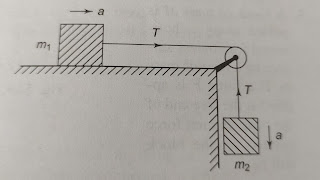
8. ভরহীন তার দ্বারা যুক্ত দুটি বস্তুর একটি ঘর্ষণ হীন টেবিলে রক্ষিত অপরটি টেবলের প্রান্তে একটি চাকার মাধ্যমে ঝুলন্ত আছে ।
মনেকরি সংস্থাটির ত্বরণ a | 
টেবিলের উপর রক্ষিত বস্তুর গতীয় সমীকরণ 

T = m₁ a  ( T = তারের টান )
ঝুলন্ত বস্তুটির সমীকরণ ,

m₂ g -T = m₂ a 
উভয় সমীকরণ সমাধান করে পাই ,
a =m₂  g /(m₁ + m₂)
T = m₁ a 
m₁ m₂  g /(m₁ + m₂)
টেবিল ঘর্ষণহীন হলে  m₂ ∠ m₁ হলেও m₁ গতিশীল হবে । 
9.একটি তারের দুই প্রান্তে দুটি ভর যুক্ত এবং তারটি একটি ঘর্ষণহীন  নত তলের উপর প্রান্তে অবস্থিত একটি চাকার উপরে রক্ষিত : 
নত তলের উপর রাখা বস্তুটির গতির সমীকরণ -
T - m₁g sinθ =  m₁ a  ( m₁ ভর নত তলের উপরের দিকে a ত্বরণে উঠছে ) 
কপিকলের উপর ঝুলন্ত বস্তুটির গতির সমীকরণ -

m₂ g -T = m₂ a 
উপরের সমীকরণ দুটি সমাধান করে পাই ,
a = ( m₂ - m₁ sinθ) g/( m₁ + m₂)
এবং T = m₂ g -m₂ a = m₂ ( g - a) 
যদি m₁ ভর নত তল বরাবর নীচের দিকে নামে তাহলে গতির সমীকরণ হবে -

m₁g sinθ -T =  m₁ a 
এবং 
T - m₂ g = m₂ a
সমাধান করে পাই ,
a = (m₁ sinθ - m₂)g/(m₁ + m₂)
T = m₂(g + a) 
10. ভরহীন তারের দ্বারা দুইটি ব্লক যুক্ত আছে এবং তারটি একটি ঘর্ষণহীন দ্বীনত তলের উপরে কপিকলের উপর রক্ষিত । 
মনেকরি  m₁ ভর টি উপরের দিকে উঠছে । এই অবস্থায় m₁ ভরের গতির সমীকরণ -
T - m₁ g sinθ₁ = m₁ a ( a = ত্বরণ )

m₂ ভরের গতির সমীকরণ -
m₂ g sinθ₂ -T = m₂ a 
উপরের সমীকরণ দুটি থেকে T অপনয়ন করে পাই ,
a = (m₂ sinθ₂ -  m₁  sinθ₁)g/(m₁ + m₂)
এবং T = m₁(a + g sinθ₁) = m₂(g sinθ₂ -a)

বহু বিকল্প ভিত্তিক প্রশ্না বলি (MCQ):
1.0.5 kg ভরের একটি ক্রিকেট বল 30 m/s বেগে লম্ব ভাবে ব্যাটে আঘাত করে ।বিপরীত দিকে 20 m/s বেগে বলটি ফিরে আসে । ব্যাটের উপর প্রযুক্ত বলের ঘাত কত ? 
a) 0.5 Ns        b) 1.0 Ns 
c) 25 Ns      d) 50 Ns   
  
2. m₁ ও m₂ ভরের দুটি বস্তু তার দ্বারা ঘর্ষণহীন দুটি কপিকলের মাধ্যমে m ভরের সঙ্গে চিত্র অনুযায়ী যুক্ত ।


যদি m₁ ও m₂ ভর v বেগে নীচের দিকে নামে তাহলে m ভর কত বেগে উপরে উঠবে ? 
a) v    b) √2 v
c) √3v         d) 2 v 
3. m এবং 2m ভরের দুটি বস্তু কপিকলের মাধ্যমে চিত্রের মত করে যুক্ত । যখন 2m ভরকে ছেড়ে দেওয়া হবে তখন m ভর কত ত্বরণে  উপরে উঠবে ? 
a) g/3       b ) g/2 
c) g        d) 2g 
4. নীচের চিত্রে যদি তারটির মুক্ত প্রান্তে F =2 mg বলে টানা হয় তাহলে m ভর কত ত্বরণে উপরে উঠবে ?

a) g/3       b ) g/2 
c) g        d) 2g 
5. M ভরের একটি বস্তুকে ঘর্ষণহীন টেবিলে অনুভূমিক ভাবে m ভরের দড়ির দ্বারা টানা হচ্ছে । প্রযুক্ত বলের মান F হলে M ভরের উপর ক্রিয়াশীল বলের পরিমাণ কত ? 
a) FM/(M + m)    b) Fm/(M + m 
c)  FM/(M - m)    d) F 
6. θ কোণে আনত একটি নত তলের উপরে অবস্থিত একটি বস্তু আছে । নত তলটি একটি লিফটের ভিতরে আছে । লিফটি যদি a মন্দনে নীচের দিকে নামে তাহলে নত তল বরাবর বস্তুর উপর কত ত্বরণ কাজ করবে ?
a) g sin θ          b) a   sin θ 
c) ( g - a)  sin θ        d) ( g + a)  sin θ
7. একটি  ব্লক 45º কোণে আনত একটি মসৃণ নত তল বরাবর পড়তে যে সময় লাগে ওই একই কোণে আনত অমসৃণ তল বরাবর পড়তে তার দ্বিগুণ সময় লাগে । অমসৃণ তলটির চল ঘর্ষণ গুণাঙ্ক কত ? 
a) 0.25        b) 0.5 
c) 0.75       d) 1.0 
8. θ কোণে আনত একটি নত তলের উপরের অর্ধাংশ মসৃণ কিন্তু নীচের অর্ধাংশ অমসৃণ । একটি বস্তু নত তলের উপরের বিন্দু থেকে স্থিরঅবস্থা থেকে   যাত্রা শুরু করে নত তলের নিচে আবার স্থির অবস্থায় আসে । নত তলের শেষ অর্ধাংশের ঘর্ষণ গুণাঙ্ক কত ?
a) μ = 2 tan θ     b) μ =  tan θ 
c) μ = 2 /tan θ   d) μ = 1/ tan θ 
9.বালি ভর্তি  একটি ট্রাক মসৃণ রাস্তায় u সুষম গতিতে চলছে । যদি ট্রাকের তলার একটি ছিদ্র দিয়ে △m ভরের বালি △t সময়ে পড়ে যায় তাহলে ট্রাকটির u সুষম গতি বজায় রাখার জন্য কত বলের প্রয়োজন ? 
a) △mu/△t             b) △mu/2△t 
c) △mu²/△t    d) zero 
10. m₂ ভরের একটি ব্লক একটি মসৃণ টেবিলের উপর আছে । ব্লকটিকে একটি তারের দ্বারা টেবিলের প্রান্তে আটকানো কপিকলের মাধ্যমে m₁ ভর ঝোলানো আছে । যদি m₁ > m₂ তাহলে সংস্থাটির ত্বরণ কত ? 


a)  m₁g / m₂     b)  m₂g/m₁ 
c) m₁g /(m₁ + m₂)  d)  m₂ g/(m₁ + m₂)
11.m₁ ভরের A বস্তু একটি মসৃণ টেবিলের উপর আছে । অপর একটি বস্তু B , ভর m₂ ,A বস্তুর সংস্পর্শে আছে । A  বস্তুর উপর F বল প্রয়োগ করা হল । B বস্তুর উপর A দ্বারা প্রযুক্ত বল কত ?


a) .m₁/m₂ F            b) m₂/m₁ F 
c) m₁ F /(m₁ + m₂)          d) m₂ F/(m₁ + m₂) 
12. A এবং B দুই ব্যক্তি একটি মসৃণ তলে 6 m দূরত্বে দাঁড়িয়ে আছে । A ,B এর ভর যথাক্রমে 50 kg এবং 70 kg । তারা পরস্পরকে একটি দড়ি দিয়ে টানছে । A, B যখন পরস্পর মিলিত হবে তখন কে কত দূরত্ব যাবে ?
a) উভয়েই  3 m করে দূরত্ব যাবে ।
b) A যাবে 4 m এবং B , 2 m যাবে । 
c) A যাবে 2.5 m এবং B যাবে 3.5 m | 
d) A যাবে 3.5 m এবং B যাবে 2.5 m | 
13.এক ব্যক্তি ইঞ্জিনের দিকে মুখ করে ট্রেনের ভিতরে বসে আছে । সে একটি মুদ্রা টস করলো । মুদ্রাটি তার পিছনে পড়ল । এর অর্থ হল - ট্রেনটি 
a) নিৰ্দিষ্ট  ত্বরণে সামনের দিকে চলছে ।
b) নিৰ্দিষ্ট মন্দনে সামনের দিকে চলছে ।
c) সম বেগে সামনের দিকে চলছে । 
d) সম দ্রুতিতে পিছনের দিকে চলছে । 
14.W = Mg ওজনের এক ব্যক্তি একটি লিফটে দাঁড়িয়ে আছে । লিফটি  a ত্বরণে উপরের দিকে উঠেছে । যদি g অভিকর্ষজ ত্বরণ হয় তাহলে লোকটির আপাত ওজন কত ? 
a) W(1 + a/g)   b) W(1 - a/g) 
c) W    d) zero 
15. একটি স্প্রিং ব্যালান্সের এক প্রান্তে 10 N বল প্রয়োগ করা হল । ওপর প্রান্তেও 10 N বল প্রয়োগ করা হল । স্প্রিং তুলার পাঠ কত হবে ? 
a) zero     b) 5 N 
c) 10 N       d) 20 N 
16. একটি ব্লক A কে একটি মসৃণ নত তল এর উপর থেকে ছেড়ে দেওয়া হল । একই সময়ে ওপর একটি ব্লক B কে সরাসরি নত তলের উপর প্রান্ত থেকে উলম্ব ভাবে ফেলে দেওয়া হলো । নীচের কোন বিবৃতি গুলি সঠিক ? 
a) দুটি ব্লকই একই সময়ে ভূমিতে পড়বে । 
b) A ব্লক B ব্লক থেকে আগে ভূমিতে পড়বে । 
c) উভয় ব্লকই একই দ্রুতিতে মাটিতে পড়বে । 
d) ব্লক B ,ব্লক A থেকে বেশি দ্রুতিতে মাটিতে পড়বে ।
17. একটি নত তলের শীর্ষ বিন্দু থেকে একটি ব্লককে ছেড়ে দেওয়া হল । নত তলের নতি কোণ θ হলে ব্লকটির ভূমিতে পৌঁছাতে কত সময় লাগবে ? 
a) √(2h/g)              b) sinθ√(2h/g) 
c) 1/sinθ√(2h/g)      d)    1/cosθ√(2h/g)  
18.M ভরের একটি ব্লক একটি নত তলের উপরে আছে । নত তলটির নতি ক্রমশ বৃদ্ধি করা হলে যখন নতি θ হয় তখন ব্লকটি পিছলে পড়া শুরু করে । নত তল বরাবর কত সর্বনিম্ন বল (F) প্রয়োগ করলে  ব্লকটি উপরের   দিকে উঠবে ? 


a) Mg sin θ              b)  Mg cos θ 
c) 2Mg cos θ         d)    2 Mg sin θ     
19. 200 g ভরের একটি বস্তু x অক্ষের ধনাত্বক 5 m/s গতিশীল আছে । একটি ধ্রুবক মানের 0.4 N বল x অক্ষের ঋনাত্বক দিকে 10 s ধরে ক্রিয়াশীল । t = 2.5 s বস্তুটির অবস্থান কোথায় হবে ? 
a) x = 1.0 m         b) x = 1.25 m 
c) 1.5 m        d) 1.75 m    
20. 19 নং প্রশ্নে t = 2.5 s বস্তুটির গতিবেগ কত হবে ? 
a) 7.5 m s⁻¹    b) 6.25 m s⁻¹ 
c) 5.0 m s⁻¹    d) zero 
21. 19 নং প্রশ্নে t =30 s বস্তুটির অবস্থান কোথায় হবে ? 
a) x = - 350 m   b) x = -400 m 
c) x = -450 m    d) x = - 500 m 
22. 19 নং প্রশ্নে t = 30 s সময়ে বস্তুটির দ্রুতি কত হবে ? 
a) 10  m s⁻¹     b) 15  m s⁻¹ 
c) 20  m s⁻¹       d) 25  m s⁻¹ 


Wave Optics

Introduction :  In  1637;Descattes gave cospuscular theory of light and derived Snell's law . The cospuscular theory predicted that if a...